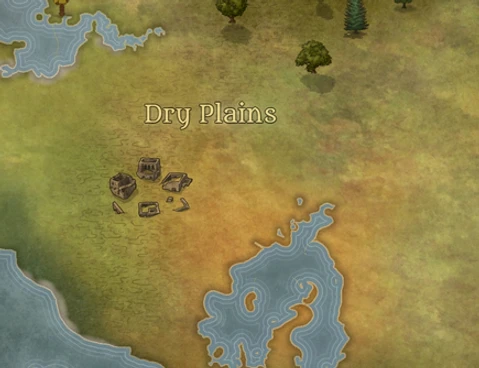
 Dry Plains
Dry Plains
The largest collective area of grasslands is equally as impressive as its unappealing appearance. Regarded as a haven for artifacts that date back as far as the Blissen, the Dry Plains is surprisingly bustling with life. Extreme winds have created a flat prairie that will easily uproot the rare tree that has faced all surmountable odds to survive on some of its worst days. Living shelters are typically angled and low to the ground to rebuff the worst of the winds' effects.
A majority of the faunids that occupy the plains are researchers and travelers. Not many will willingly stay on the plains for lack of water and fertile soil. Those who do stay are welcoming and incredible storytellers. Myth and history dance seamlessly together around the campfire at night; the warmth of fermented fruit and flame at odds with the empty grasslands' wailing.


The etymology of "Dry Plains" is self-explanatory; these large plains sprawling across the heart of Atalav are, in fact, pretty dry!
History and Mythos
It is said that the Dry Plains were once not dry at all. It was once an incredibly bio-diverse area where rivers ran wild, trees bent low with fruit, and the grass was tall enough to lose your kin in.
But something happened here that the stories can’t agree on. Some say Herne buried something too powerful to destroy - an ancient grief and power that could physically rot one from the inside out. Corrupts say he simply turned his back on the land, leaving it to dry and harden under forgotten skies. Whatever the cause, the rivers choked on dust, the winds rose, and time began to strip meaning from the world here.
Now, the plains are said to be a place where Herne left to forget and mortals go to remember. The wind is Herne’s exhale, some say. Long, tired, and indifferent. Others believe it’s not Herne at all, but a different, older entity buried beneath the earth, one who listens but never speaks. Travelers claim to hear voices that do not belong to them, memories that are not their own, stirred up by wind and relic.
The Blissen ruins that litter the land are seen not as remnants of a proud civilization, but as half-erased warnings. Every artifact unearthed is treated with a mix of awe and caution, as if the land itself wants you to forget what you’ve found.
Religious Practices
There aren’t religious rituals tied to specific communities or temples out on the Dry Plains. With no stable settlements and few lasting structures, faith here doesn’t root itself in buildings. Worship drifts to be carried on wind and memory. The faunids who cross this land - traders, scholars, wanderers - inherit their beliefs not from priests, but from hushed stories told beside flickering campfires or in journals passed down like heirlooms.
These are not grand ceremonies, but weathered traditions stitched together by generations of survival. A carved stone left at a forgotten shrine. A breath held during a sudden gust. A soft-spoken name whispered into the endless grass. The Dry Plains teach that Herne isnt always listening, but that doesn’t mean you shouldn’t speak.
Worship here is a conversation with the unseen, born of long silence and wind-chapped resilience. Offerings are small. Sometimes just a moment of stillness. A verse of a fireside song, or a thumb pressed to an ancient ruin. They aren’t done for reward. They’re done because someone, somewhere, once also survived by doing them.

Current Status
There's no established towns and no sustained infrastructure. Instead, the plains function as a transitory space, a corridor between destinations. Windstorms are frequent and unpredictable, carving new paths and erasing old ones, which makes any form of permanence difficult, if not impossible.
Though inhospitable, the Dry Plains are far from empty. Wanderers, researchers, scavengers, and storytellers move through its harsh landscape, drawn by rumors of ancient Blissen relics or by the pull of solitude and space to think. Makeshift camps and wind-worn waystations serve as brief oasis. Travelers leaving behind stone markers, symbols, or etched memories for those who may come after.
Infamy

Strong winds can and will disorient anyone traveling on the Dry Plains. These winds are strong enough to topple over small Faunids and unsuspecting companions.
Bandits are extremely common in this area. Riding in with bandanas and clearly visible weapons, Dry Plain bandits will rob you for the breath in your lungs.
Water is hard to come by and must be rationed. Travel becomes a ticking clock with each final drink you take. Blissen-dated artifacts are a commodity here in The Dry Plains- but beware of their lingering radiation.
Architecture
The architecture of the Dry Plains is shaped entirely by survival. With harsh winds that tear through the grasses and strip anything left unguarded, structures here are low to the ground, sloped, and often half-sunken into the earth. From a distance, many shelters resemble mounds or animal dens, designed to go unnoticed and undisturbed. Materials are strictly practical. Dried grass, compacted soil, animal hides, bones, and the occasional salvaged arttifact from Blissen ruins. Wood is rare and sacred, used only when absolutely necessary. Nothing built here is meant to last forever; most shelters are temporary, abandoned, or rebuilt as the land demands.
The few permanent waystations scattered across the plains serve both as shelter and as quiet shrines. These simple constructions are often marked with carvings or offerings left by travelers. Walls inside may be etched with story-signs or survival cervidic runes. In the Dry Plains, where temples do not stand and communities do not remain, these structures carry memory. Each one is a fragment of a collective story passed not by tradition, but by necessity. The architecture is not just a reflection of primitive plains life - it is a living response to a land that offers no permanence.