 Makino & Rosen Forest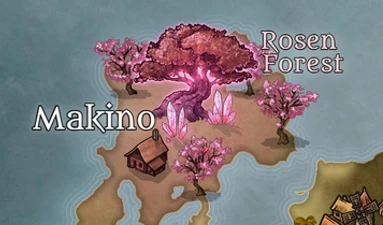

Makino & the Rosen Forest
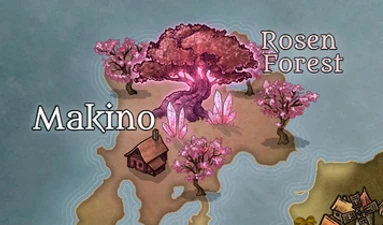
This secluded but highly developed island utilizes X usage for its day-to-day functionality. Outsiders are looked down upon; Makino discourages them from entering the city. Civilians are extremely protective of the environment, and secrets litter every nook and cranny. Lace and silks, and ornate jewelry and adornments feature as the city’s exports into the rest of Atalav. The crowning jewel, however, is the iconic pink sakura-esque trees and pink crystals that make up the Rosen Forest and its dense foliage.
Nothing is quite as iconic as the pink sakura-esque trees that make up the beautiful Rosen Forest. Pink crystals can be seen all across the island but are most prolific within the denser foliage. Glowing spirits can be seen dancing between branches in endless glee as they await the annual Fawning.
Glowing spirits dance between branches in endless glee each year as they await the annual Fawning.

The etymology of "Makino" seems to stem from an archaic word that meant "Pasture Field" or "Grazing Field."
Demonym: Makinae (plu.) Makino (sing.)
Makino rarely has more than 500 Faunids living in central Makino, the area directly adjacent to/surrounding the Rosen Forest. The area that extends towards the Antler Islands has slightly more inhabitants, around 800, leaving Makino with a population consistently falling below 1300 faunids.
History and Mythos

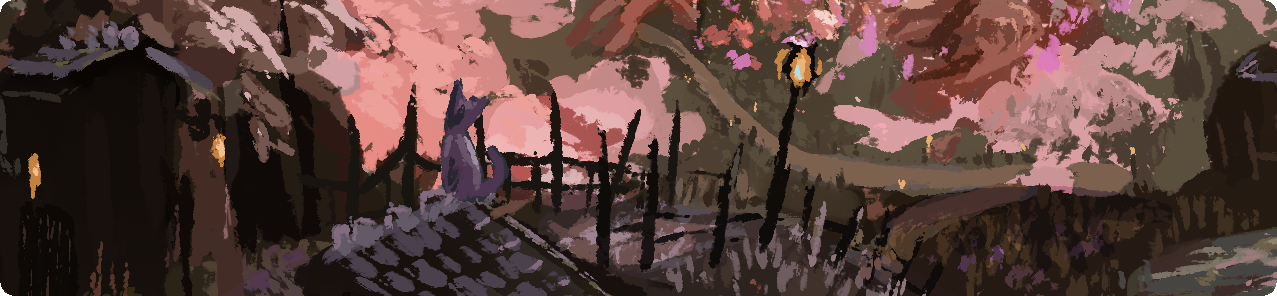

Herne put their most devout followers here.
Crystals are rumored to be herne's antlers protruding through the earth.
Pure corrupted hooves have never touched Makino soil. Anyone noticeably corrupting is publicly executed as a show to show their dedication. It is not a cheerful ceremony and takes months to plan and is akin to a funeral. No faun has fully corrupted in the timespan of the execution and is at minimum semi-conscious. Due to the extreme consequence/ritual, the victim will typically only delve deeper into hysteria and disbelief. It is rare to escape once convicted. There are rumors of corrupting fauns to run away to the antler islands.
Not only is the magical concentration spread throughout the soil, but it is tangibly strong within the crystals that grow from the ground. Being one of the few areas where these large trees reside, they are seen as a symbol of Makino. The Purity collection was founded in Makino. Based in means of growth and healing, the purity collection is the second most common form of X thought.
Religious Practices
The fundamental part of religious practices in Makino is a) public appearance and b) object-based worship. Because Makino is a small town with a significant productive output (even if most of it is maintained within Makino itself), they chalk up a lot of this up to the blessings of Herne. In order to further the graces of Herne, Makino therefore regularly offers their own creations to the Rosen Forest, which is considered the purest (yes, the) source of Herne’s “affections”, according to Makino. The products which are created out of Rosen Forest resources are, therefore, invaluable when it comes to worship significance, but are still treated as common goods in Makino since, to them, they are part of that circle of selected faunids.
When goods are offered, they are never left out; it is the act of offering that is sacred. The items themselves are allowed to be brought back home, but cannot be bartered for, only given as gifts. However, you cannot simply gift items you would like to scrap. Every item offered must be of as high as a quality a contributor can provide. Gifts are rarely provided by a faunid more than once every two to three months, whereas attendance is required. Consistent, decent offerings are prioritized over grand, rare gestures, as to maintain good relationships between Faunids through “gift-giving”/offerings.
Public worship is led by one of the three political leaders – three in order to allow a majority. These political leaders double as religious guidance figures, as these are considered to be inseparable since all leadership should return and be informed by the worship of Herne.
The corruption hunts always lead back to a Makino’s public worship of Herne. Because of the community-based society, Makino has regular gatherings (twice a week) for worship, often centered around inspiration and production, or asking Herne for aid in the cultural or creative endeavors.
Whenever a Makino returns from the outside, typically merchants, they are required to sit through one of these public gatherings in order to be cleansed of outside influences and supposed spiritual forces of corruption. The effectiveness of these rituals has not been confirmed, but it does provide relief to those living close to the returnee.
Returnees are in precarious situations and most vulnerable to corruption accusations, no matter the region they have traveled to.
Current Status
Infamous for:
Corruption hunts:
Makino regularly uses political and social pressure to force perceived threats or inconveniences out of Makino, including falsely accusing other faunids of corruption. Being removed from Makino once – outsider or not – means a permanent ban of entry. If caught attempting to reenter, the consequences will be severe.
Suspicion and paranoia are rampant and only exasperated by Makino’s isolationist culture; trust your neighbors, but know they would hand you in for a corn chip.
Inhospitality:
Makinae are not known for promoting tourism. Most non-Makinae merchants or visitors who wish to enter the city must obtain a permit. The permit outlines expectations of conduct, bartering, and requires a signature. However, due to the high quality of Makino products, most merchants and travelers are willing to commit to the extra steps for an armful of silk or a sack of Makiros tea. Information hoarding:
Makino is notoriously difficult not only to enter but also to study in. Though its local trades are known across Atalav, they’re not meant for outsiders to practice, except for in very rare cases. The Makino library, a small but extensive book collection run by a founding family, is forbidden for outsiders. Originally, the library had some level of public access, but after a visiting Faunid (who later on fell to corruption) decided it was her right to not only read but also take with her, several previous volumes, the library’s doors locked. Books are no longer allowed to leave the premises.
Rask pollen: The nasty side effect of Rosen flowers, the Rask pollen is not only large, bright pink, and stuffy, it also tends to migrate away from central Makino and hit the coast and outside settlements the hardest. Good luck cleaning pollen out of your fur! The sniffles are incoming and you’d do best to coat your home in sticky tack (a honey and gum mixture), which will catch the flurry and then be peeled off once dried (sticky tack takes roughly ten days to dry completely). Don’t let your fawns eat the Rask-covered sticky tack, it does look rather tasty.
Specialties:
Producing the Rosen dye, a dye unrivaled in how bright pink it is – this dye can only be produced once a year, during spring. As the Rosen tree leaves regrow (these trees do not wither, but rather ‘shed’ as new leaves come in during the spring season), the discarded pink leaves & flowers can be collected. The leaves are used for the production of the dye (which is then brought by Makinae merchants across Atalav), whereas the flowers can be used for producing the sweet, floral tea known simply as the ‘Makiros Tea.’
Producing dye is not a full-time job, but the skill takes years to learn as an apprentice. The production of Rosen dye (and the collection of Rosen leaves & flowers) is reserved for those who live on Makino.
Fun fact: part of the process relies on vinegar, which is made using water mixed with wine, as well as a vinegar starter (more wine!). As Makino heads closer to Rosen dye season, Makino merchants looking to barter for wine make their rare trips outside of the city (red wine preferred, as small quantities of the red aid with the color development!).
Jewelry using Rosen Quartz, which is only allowed to be sold and used in production by Makinae. Due to the difficult nature of the quartz, most jewelry smiths require a minimum of five years of apprenticeship before being able to proceed past the beginner stages of stone carving (basic shapes and crude details). Top jewelry is produced by jewelry smiths who have been performing their crafts for decades, and these items are not commonly found due to both limited quartz and labor time.
The Rosen Quartz is only harvested in minimal quantities, strictly supervised by the Rosen Forest Guild, which oversees the maintenance of the Rosen Forest (including harvesting, events, and surrounding settlements to preserve the environment). Every year, three crystals (roughly the size of half a Faunid) are taken from the forest. Each major jewelry smith family (family here referring to a jewelry smith shop and its apprentices) receives one stone, as agreed upon many, many years ago. A Rosen Quartz can regrow to this size within five years, which means roughly the same amount of quartz is present at any time in the Rosen Forest.
Lacework & Silk: A lot of Rosen Dye is reserved for the lace and silk produced in Rosen. Makino residents are often seen wearing the color as is, without embroidery, as a source of cultural pride and unity. Lacework added to silk is preferred over embroidery, as it maintains both traditional types of fabric handiwork of Makino.
Makino silk and lace is made from a local type of larvae living in the trees surrounding the Rosen Forest. Due to the amount of X present, they produce an abundance of silk in their cocoons, and the larvae grow enough to emerge from these cocoons within mere days. The larvae population lives very brief lives, and roughly every 3 months the population is completely replaced.
Most common jobs:
Tea house staff – servers.
Fabric dyer and weavers; particularly silk and lace.
Rosen Forest keeper; tasked with the oversight and maintenance of Rosen Forest plants & harvests.
Rask pollen cleaner – a seasonal, first-time job typically held by young Faunids and/or Fawns.
Infamy

Isolated: most danger is related to flooding during certain seasons.
Low inside societal conflict level; Makino is incredibly community-oriented and is highly collectivist
Political instability; despite its collectivist society, Makino politics is fraught with instability due to the awareness that the rules of the game can be skewed.
Outside hostility/not travel friendly; corruption claims can be levied against visitors should a ‘need’ artiste.
Rosen Forest allergens are more harmful to outsiders without proper exposure since fawnhood.
Architecture
Due to the coastal location, most of Makino’s buildings are made out of either wood or limestone. Due to a long history of rare but highly destructive floods, many of the houses closer to the coast and edges of Makino are built on low stilts made out of thick stone and reinforced with wood whenever stone is not pliable enough. Central Makino houses are almost always built completely out of wood, but these houses are commonly decorated by paint (rarely the entire building, but rather accents such as the corners or window sills, or parts of a door). Because of how small Makino is, two-story houses are common, but these have fortified foundations out of stone, similar to the coastal houses. Makino families tend to live in generational houses – usually, young faunids inherit their parents’ houses, and elder members of the family remain in the house as well.
| ← Locations | The Salmon Coast → |